
2015 Buick Verano
Resetting the Tire Pressure Monitore System
I recently purchased a 10 yr old Buick Verano that was in great looking condition and seemed to be sound, mechanically. I’ve been happy with it overall, and no complaints.
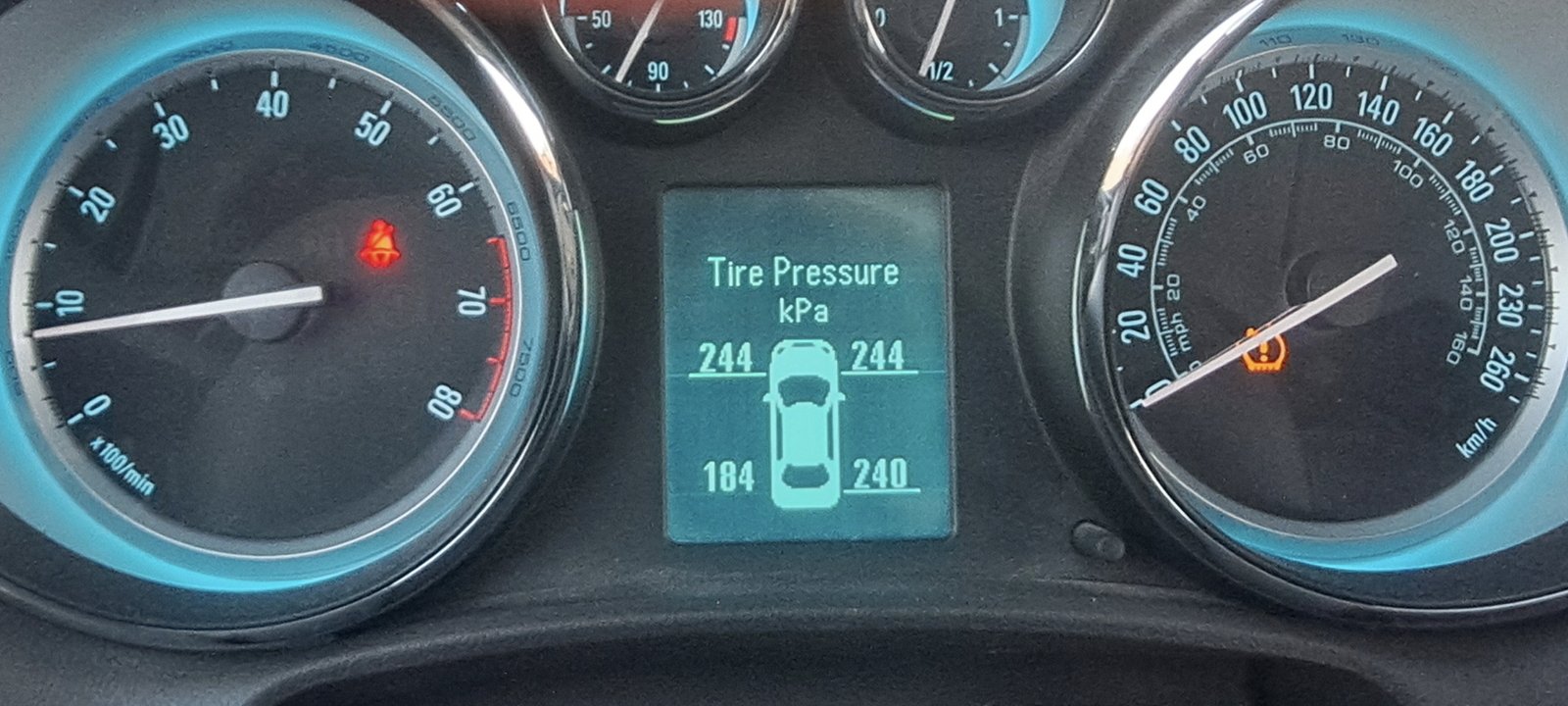
I noticed that the dashboard screen that shows the tire pressures was showing that one tire was a little low. Since the tire indicated didn’t actually look low to me at all, I checked the pressure with an old tire gauge that I had handy. The tire in question (rear driver’s side) was at the pressure it should have been. So I proceeded to check all the tires with a tire gauge, and they were all fine according to my pressure gauge. One tire, (front passenger side) was just a little bit low, but not an issue in my opinion. I thought it shouldn’t be coming up on the dashboard warning system as it was only a few psi low.
I continued to monitor the dashboard display for the next wek and soon the tire pressure dropped enough to trigger a constant warning light. So I checked again and the tire indicated was still fine, but the front tire was again a little low. I pulled out my trusty old air pump and brought all the tires up to spec, to about 35lbs. Again only the front passenger side was only a little low, but not by very much.
So, whats going on?? The problem tire was supposed to be the rear left, not the front right.
It turns out that when tires are removed & put back on in different positions for any reason, the tire shop is supposed to reconfigure the on-board computer so that it knows which tire is which, in each position. Possibly the sensors in each tire are slightly different frequencies in order to differentiate between them? I don’t know the full technology behind how the car & its tire pressure monitors are connected, but apparently they are not ‘Smart’ enough to know one tire from another. I has to be told somehow which tire is where.
 So apparently somebody had all the tires off the car and did not put them back on in the exact same locations, and they didn’t reconfigure the system at all. It may have been a tire rotation, or the safety check a few weeks ago when I purchesed the car, as they would have likely removed the tires to see the condition of the brake components, or whatever other reasson.
Anyway, there is one tire losing air very slowly, and the car thinks it’s the rear driver side when it seems to be the front passenger side tire. This is not a huge concern, and is easy to fix the sensor location issue, while fixing the actual air leak may be a bigger issue.
To reset the tire locations in the Buick’s computer, all you have to do is go into the car’s reset mode, follow a simple proceedure and save the new information. For this, you can either work manually by releasing air until the pressure sensor notices, or you can rent or borrow a specialized proximity tool that triggers the sensor when activated very close to the sensor. When you do this, you have to do all 4 tires in the proper sequence, as the computer has been designed to work in only one way.
Here’s the process:
It is reasonable to begin by pre-over-inflating your tires to about 40psi (give or take).
- Put the car into its ‘On’ position, but do not start the car
- The dashboard comes to life
- Navigate the display to the screen showing tire pressures.
- On the Turn Signal lever, press & hold the button at the end of the lever arm. (Your specific car may have a reset button elsewhere, consult your car’s manual)
- The car’s horn will honk twice, indicating it’s ready to begin
- Get out of the car and start with the Front Driver’s side tire
- Let approx 10 or 15 psi of pressure out of the tire, until the horn honks once.
- Move to the Front Passenger side tire, let air out again until the horn honks once.
- Move to the Rear Passenger side tire, again let out air until the horn honks once.
- Go to the opposite side (Rear Driver’s side) and let out air until the horn honks, this time TWICE.
- This indicates that you’ve succeeded in telling the car where your tires are, and which is which.
- Now that you’ve let air out of each tire, you’ll need to re-inflate each one back up to spec, as they’ll all now be under-inflated by some margin. (Thats why over-inflating them ahead of time may help you to NOT bring any tire down in pressure too much)
- Re-inflate each tire back up to spec for your vehicle, and now you’re finished!!
Congrats, You’ve reset the tire placement issue, and you may also have resolved an incorrect pressure reading -if in fact there was one.
Continue to monitor your problem tire, if you have one. If it does continue to lose air, at least the dashboard will correctly show you which tire it is.
While the obvious reason that a Tire Pressure sensor indicates low pressure may be that it is in fact losing air through a slow leak of some kind, there may also be other reasons such as a faulty aire pressure sensor, or possibly the sensor has become clogged or damaged during a tire change or from an air-leak sealant. You’ll have to determine the issue if problems persist.
But hold on !! There can be even more obscure things happening behind the scenes that could cause phantom readings warning of low tire pressure, as I soon discovered …
I noticed my neighbour one day last week loading a remote controlled airplane into his trunk and I wondered about frequency interference. Upon researching a little bit, I found that RC cars, trucks, airplanes and possibly even drones, could be using a frequency that is close enough to a tire pressure sensor that it could triggerr a false signal in a car.
We also recently added a new garage door opener remote control for another new car we purchased recently, and that remote also uses a frequency that is close to the range used by air pressure monitors in cars.
So there did exist a possibility that there never was a problem with low air in any tire in the first place. But I did discover that the tires were misplaced in the system.
Then another mystery came up.
2019 Buick Envision
I also had another buick that had been being driven by a member of my family for a while. When they gave it back to me, I found that this car ALSO had a low tire indicated on the dashboard display. AND it was indicating the same tire as the Verano, the Rear Driver’s side tire.
So what gives ?? My first thought was that this may be proof that either the new garage door opener or the neighbour’s RC plane was using frequencies that were interfering with my TPMS in both cars.
So I just ignored it as the tires looked physically to be just fine. I went off on a road trip without manually checking the tires at all. Well that was not a good choice as it turns out.
During my road trip (over 4000 kms, one way) that tire on my dash display continued to show that the pressure was dropping. I just kept going. Well, eventually I did check the tire pressures with my gauge, and yes, this car actually DID have dropping pressure in the indicated tire, and I needed to get air soon. Luckily I did have a tire pump, and I re-inflated the low tire & continued on my long trip.
As I drove, I began to wonder if my actual low tire in this Buick Envision had correctly sent out it’s low pressure signal, and this car was showing the correct info, but ALSO maybe the Verano received thatsame signal and ALSO showed a low tire, when it didn’t actually have a low tire at all ?? Can cars do that ?? They’re both Buicks and their computers are not that different from each other, with the same menus & similar controls, so why not ?? They were parked right next to each other so in all likelihood, they were both within range of a signal …
I don’t know yet, but will investigate further when I return home!!
Cheers !!